Showing posts with label traditions. Show all posts

Thursday, January 30, 2020

Catalan cuisine is part of Mediterranean cuisine and its typical example

Catalan cuisine is part of Mediterranean cuisine and its typical example. Most often references are made to the food of Catalonia and Northern Catalonia, and occasionally Andorra but some contemporary authors like Josep Pla, Jaume Fàbrega, Eliana Thibaut i Comalada, Ferran Agulló and the English-language writer, Colman Andrews, talk about shared gastronomy throughout the Catalan cultural area, including the Valencian Community, Balearic Islands, La Franja and Andorra, and therefore it would be best referred to as the cuisine of the Catalan Countries.
Other authors consider, however, that there are different Valencian and Balearic cuisine. On the other hand, the governments of the Valencian Community and the Balearic Islands, do not support this interpretation, although they do not declare otherwise, while the Generalitat de Catalunya gives various views depending on the source consulted.
On the other hand, it is worth mentioning the local presence of, to varying degrees, different cuisines, such as xurra (from the comarques xurres of Valencia and Canal de Navarrés), castellana (from Baix Segura, the Vall de Cofrents and La Plana from Utiel, as well as parts of Alto Vinalopó, Vinalopó Mitjà) and Occitan cuisine from the Vall d’Aran and Fenolleda. It should be also added that Catalan cuisine has left its mark in Murcia thanks to its historically Catalan population and the historical contact between Murcia and Valencia.
Escudella is a typical Catalan broth

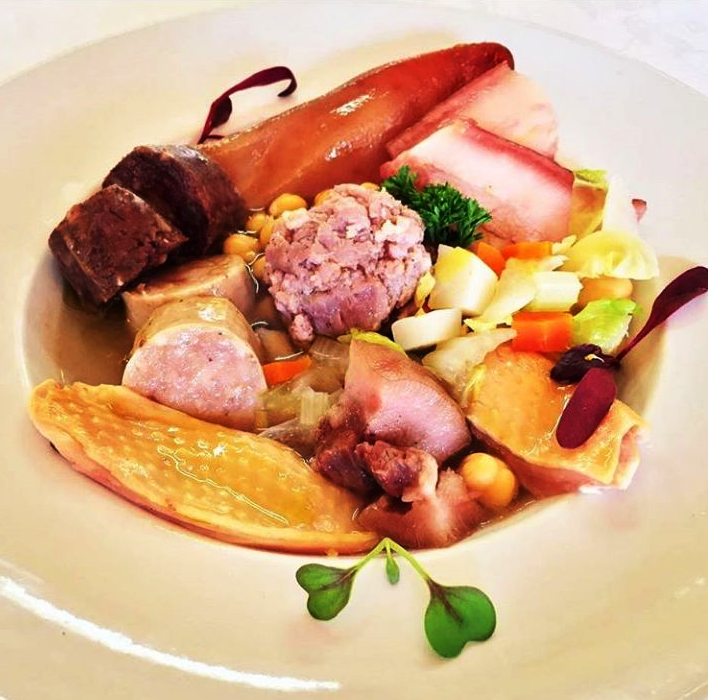
Escudella is a typical Catalan broth and, essentially, it is the same dish as the putxero with meatballs or broth with meatballs from Valencia. It is made by simmering meat in a pot with vegetables such as chickpeas, potatoes and cabbage. Usually, onion or leek, celery, carrots and one or two cloves of garlic are also added. Because it is a hot dish, it is usually eaten in winter. It has an intense, moderately salty flavour depending on the variety of ingredients that are used. The level of saltines depends on the taste of each person, although generally it is advisable not to add salt as its already contained in the ingredients. The texture of escudella is usually very soft, although it can be thickened with meat or by adding grains. It does not have a specific recipe since it is a traditional dish and each person, family or town preppers it in their own way. At Christmas, it is usually cooked with soup de galets, a large pasta that is sometimes stuffed with small meatballs.
Carn d’olla (traditional stewed meat) is usually made up of black and white sausages, pilota (meatball), lean beef, a bit of lamb, chicken breast, some pork cheeks or ears, and bacon.

All about botifarra sausages

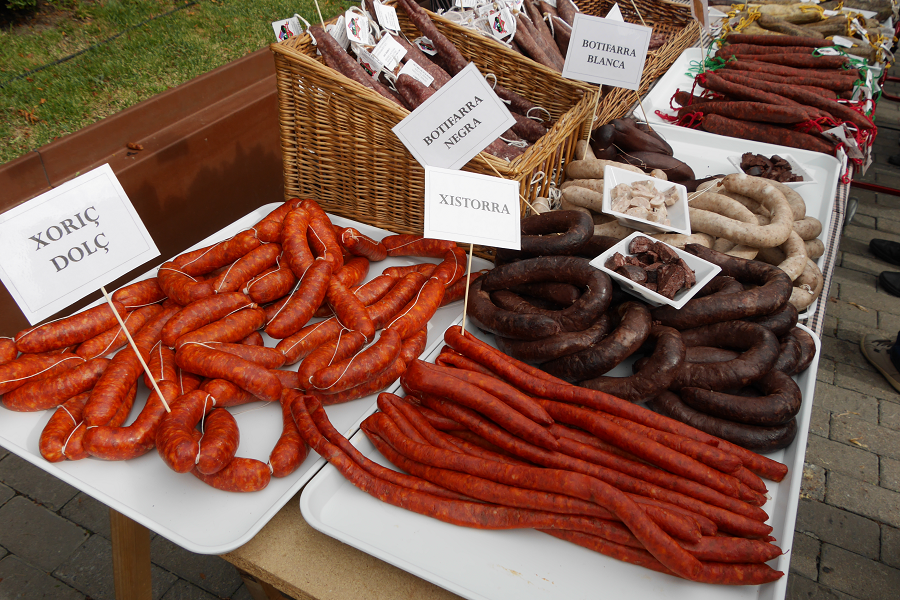
Botifarra is a type of sausage made by stuffing intestine of pork with minced and marinated meat from the same animal.
Fresh Botifarras
These sausages, also called botifarra vermella, roget or simply botifarra, must be cooked before eating them, often on a pan or on a grill, and they are served whole as a meal with some accompaniment. In Catalonia, botifarra with beans is very typical. They are those that are used on the botifarrades.
They are red before cooking and pink once cooked. They usually contain some pepper, often also garlic and parsley. Sometimes the minced meat is roasted or mushrooms are added before stuffing it in the intestine. It is also known as botifarra crua (eng. raw) or llonganissa in some parts of the Catalan Countries.
In the Valencian Country, except for the blanquet, a white botifarra, the botifarra is always black, dry or raw, and it is made with pork blood, lean meat, bacon and in some cases with some meat from pork head. There are varieties of it, with meat, onion and rice. Usually it is eaten fried or roasted, with the fat that drains out, and it is also eaten raw when dried. There are cooked varieties such as botifarra cuita or botifarró. Another typical one is the catalana with truffle, a sausage to eat in a sandwich or as tapas. The city of Ontinyent is known for the preparation of its typical Valencian sausages, although since Requena has become part of the Valencian Country in the 19th century, its sausages have become very popular. The fresh botifarra is known as llonganissa and is knotted with cords every 10 or 15 centimeters, making portions. It was called roget in the past and still, in some places, the fresh chorizo sausage for roasting or frying is called so.

The calçotada is a food event that has become the most typical and traditional way of eating calçots

The calçotada is a food event that has become the most typical and traditional way of eating calçots (type of green onions), strongly tied to celebratory gatherings. In Valls, the city where the calçotada originated, it is celebrated at the end of January, since the year 1982, it is the most famous event of calçotada. Calçotades usually take place from the end of autumn to March or early April, depending on the season.
The first dish of a typical calçotada menu is calçots (usually between 10 to 20 per person), served wrapped in newspaper to keep the temperature, served with a typical sauce, called salvitxada or romesco. Followed by grilled meat with toasted bread, accompanied by red wine or cava.
The calçots are served directly from the grill and it is necessary to peel them and dip them in the sauce. For some years now, especially in restaurants, it is customary to put on a bib to avoid spoiling clothes, but traditionally they were not used.

What is Spanish jamon and prices

Jamon Iberico & Jamon serrano: Spanish ham. Prices in Andorra 
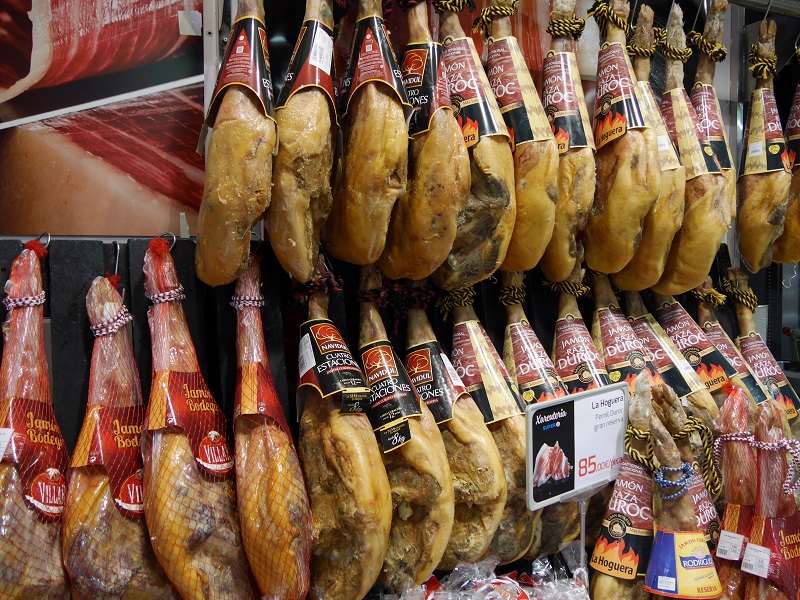
Jamon is the most famous national dish of Spain, made from a pig’s leg. The true Spanish jamon, in accordance with tradition, is prepared and aged for up to 1 year. Preservatives in production are not used, therefore, hamon is considered a rather expensive delicacy.
Traditionally, the most common on sale jamon is divided into 2 types:
– Jamon Serrano – a semi-blooded pig breed without Iberian blood or with a small presence of Iberian blood. A distinctive feature of Hamon Serrano is the hoof of a pig of whiter light (white) color.
– Jamon Iberico – a pure Iberian breed of pigs is used. A distinctive feature of Hamon Iberico – the pig’s hoof must be black (pata negra) .
Among the most expensive types of jamon: Recebo is made from pigs, fattened by acorns with the addition of leaves or stems. The most expensive jamon – Bellota, is made from pigs, fattened only by acorns (the taste is similar to the taste of wild boar).
Jamon also has a classification according to the time-preparing principle:
Curado – about 6-8 months
Reserva – about 9-10 Months
Bodega – about 12 months or more.
Origin of the delicacy
The first recipe for making cured ham was written in a book by Cato the Elder (lat. Marcus Porcius Cato) in about 170 A.D. Thus, the age of this delicacy is more than two thousand years old. The recipe has not fundamentally changed to this day: pre-salted pork gammon hung in a cellar from the ceiling, where they had to hang all winter.