Showing posts with label attractions. Show all posts

Friday, January 31, 2020

Girona

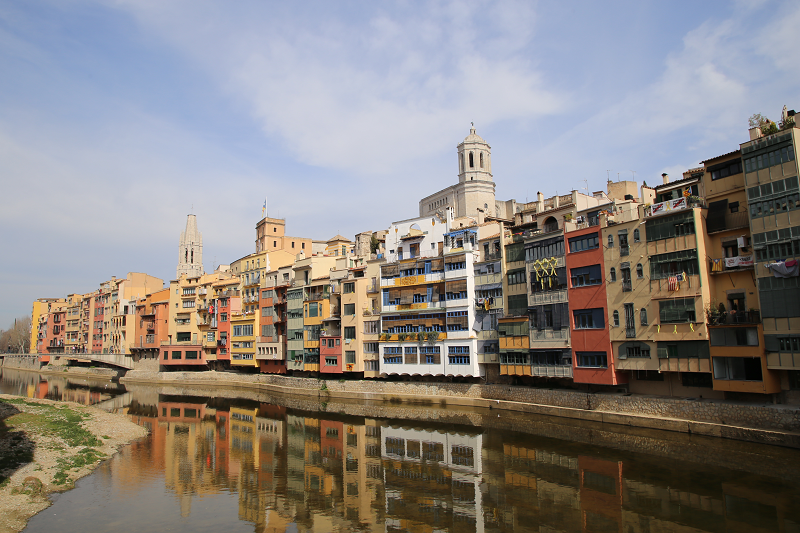
Girona (cat. Girona) is a city and a municipality in northeastern Catalonia, its the capital of the comarca Gironès and the province of Girona. It belongs to the area of the Comarques Gironines.
The city lays at the confluence of four rivers: Ter, Onyar, Güell and Galligants, at an altitude of 75 m a. s. l. Its municipal boundary limits to the north with Sant Julià de Ramis and Sarrià de Ter, to the east with Celrà, to the southeast with Juià and Quart, to the southwest with Fornells de la Selva, Vilablareix and Salt, and to the west with Sant Gregori.
The first settlers were the Iberians of the Indigees tribe, located in the higher settlements that surround and enclose the Girona plain, such as the gorge of the current Sant Julià de Ramis, which was the most important. In the wake of the Sertori wars (82-72 BC), towards 77 BC, Pompey built an oppidum (fortified walled square) on Via Heraclea (future Via Augusta) to defend it and fight against the sedentary Sertori, the faction of the Populares, who had risen armed with the Roman Hispania against Sulalla of the faction of the Optimates who controlled the power in Rome. It is then, for these military needs, that the Roman occupants founded the original Girona, which was called at that time Gerunda, whose etymology has not yet been clarified, although it could mean “between the Undarius”, name of the current river Onyar in the Iberian language. See here more history
Its Old Town or Barri Vell is one of the most evocative in Europe, and has some monumental elements that are unique on the continent. It is delimited by the so-called Passeig de la Muralla, the round walkway on the old Carolingian walls from 9th century and the Late Middle Ages (14th and 15th centuries). Among its monuments are the Call (former Jewish quarter, the best preserved in Spain), as well as the famous and colorful Cases de l’Onyar (houses on the river Onyar), and above all there is the Cathedral, with a very unique large nave, which is the widest in the world in a Gothic style.
Thursday, January 30, 2020

Perpignan – a former capital of the Kingdom of Majorca

Perpignan (Catalan: Perpinyà) is the capital city of Rosselló and Northern Catalonia. Historically, it can be considered the capital of the county of Roussillon, the kingdom of Majorca, and the province of Roussillon.
It is divided into 6 cantons which serve as electoral districts: the 6th (Perpignan-1), 7th (Perpignan-2), 8th (Perpignan-3), 9th (Perpignan-4), 10th (Perpignan-5) and 11th (Perpignan-6), the communal territories of Bonpàs, Santa Maria la Mar and Vilallonga de la Salanca are included inside the 7th one, the one of Cabestany is within the 8th canton, the one of Cànoak in the 10th and the one of Toulouges in the 11th. These act as an electoral constituency for the elections to the General Council of the department of the Eastern Pyrenees, of which it is the prefecture.
In the last years the city has been promoted with the catchphrase Perpignan la Catalane / Perpinyà la Catalana. In 2008, the city was distinguished as the Capital of Catalan Culture.
On June 11, 2010, the municipal plenary approved, unanimously, the Municipal Charter for the Catalan language, which establishes Catalan as the official language of Perpignan, along with French.
Location and general characteristics of the territory
The commune of Perpignan, with an extension of 680,700 hectares (it is the second largest commune in Roussillon), is located in the center of the region and plain of Roussillon, although part of the territory may be considered as part of the adjacent sub-communes of the Riberal de la Tet and La Salanca. It is crossed by the Tet river, besides other water streams like the Bassa, coming from Aspres.

Toulouse

Toulouse (fr. Toulouse) is a commune in the South-West of France, divided in half by the Garonne River and located near the border with Spain.
The violet culture development in the nineteenth century led to the fact that they chose this flower as the city’s emblem and the city itself earned its “pink city” name.
Toulouse has historically been the capital of the Visigoth kingdom (an early feudal state entity, historically the first of the so-called barbarian kingdoms that developed on the territory of the Western Roman Empire during its collapse in the 5th century. The capitals were Barcelona, Toulouse, Toledo, Narbonne, it is the Languedoc historical capital as well.
Toulouse is the capital of the Occitan’s Upper Garonne department and the Toulouse metropolis headquarters (a metropolis that unites part of the Toulouse agglomeration in Upper Garonne and has 37 municipalities) today.
Toulouse is France’s fourth most populous municipality after Paris, Marseille and Lyon. About 1.4 million residents lived in the municipality in 2015.
City History
The Gallic peoples confederation occupied West Languedoc from the middle of the third century BC, long before the Roman settlement; there is the belief that they were the first settlers of Old Toulouse, which was located several kilometers to the South from the modern Toulouse. Local settlers had trade relations with Spain, Italy and the rest of Gaul; they exchanged wine, wheat, leather and metal products.
Romans conquered Toulouse (Tolosa in Latin) in 107 BC. The Gallo-Romans built here, as in other large cities, aqueducts, as well as a theater amphitheater and roman baths buildings. They surrounded the city by the huge brick wall; some parts of it still remain.